| Technique | Use |
|---|---|
| Multiple regression | Explain an outcome of interest, after accounting for the influence of other factors |
| Ensemble regression | Predict an outcome of interest, using a collection of regression models |
| Factor / Principal Component Analysis | Reduce a set of correlated variables into a fewer number of 'factors' or 'components' |
| Item response theory | Validate the hypothesized measurement construct of an item |
| Conditional inference tree | Search for statistically significant splits in the data across different pathways |
| Random forest | Identify the most salient predictors of an outcome of interest using a collection of conditional inference trees |
| Causal tree | Identify variation in a treatment effect in the form of a decision tree |
| Causal forest | Identify the most salient variation in treatment effects using a collection of causal trees |
| Bayesian network | Estimate probabilities between a set of variables |
| Bayesian priors | Use stakeholder knowledge to co-create baseline values of an outcome of interest |
Data Science and Advanced Analytics
Melanie Murphy, Brian Calhoon, Dan Killian
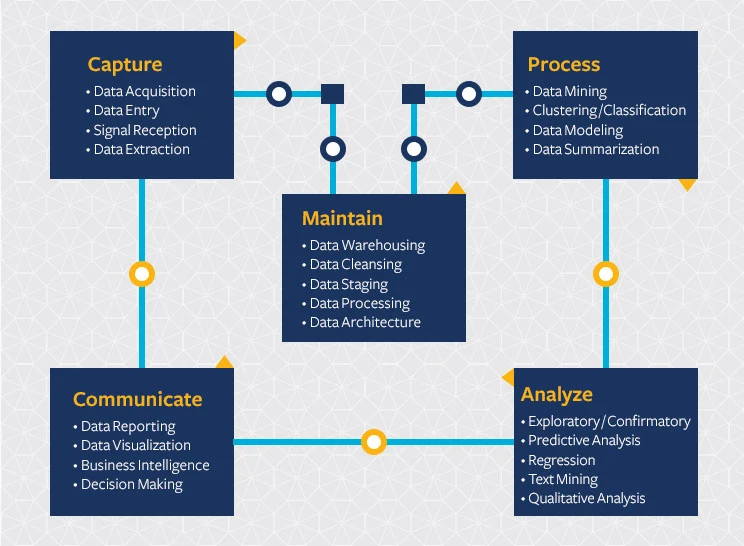
What is Data Science? Advanced analytics?
Data science: The extraction of learning from data
Advanced analytics: The application of methods that learn from the data
Robust external demand for advanced analytics
USAID’s 2011 evaluation policy remains in force, offering the opportunity for impact evaluations
USAID references analytics in its solicitations (simulation, social network analysis, modeling)
New data sources require deeper understanding, processing, and analysis
Robust internal demand for advanced analytics
We lost our analysts!
MSI junior / midlevel staff interested in gaining skills and experience / dedicated experience path
MSI needs to document and build its past performance and capabilities for new business
Need to justify / defend analytical choices
Data science and advanced analytics
Three primary areas of action
- Best practice application of technique to extract learning
- Build capacity of interested staff
- Document past practice to help win new business
Application of technique to extract learning
Build capacity of interested staff
- Structured trainings, hopefully at least once per year
- 4-12 brown bag sessions per year
- Weekly office hours / on-demand consultation
Document past practice and identify new opportunities
- Inventory of techniques, activities, and analysts
- Review existing task pipeline for opportunities to apply technique
- Demonstrate new techniques to expand performance and capabilities
Tasks
- Build and maintain trackers of techniques, where they were used, which staff implemented them
- Identify interested and capable staff
- Develop comms on current performance and capabilities
- Develop how-to manual / cookbook on analytical workflow
- Develop content for training and brown bag sessions
Interested? Please follow link in the chat.
Thank you!